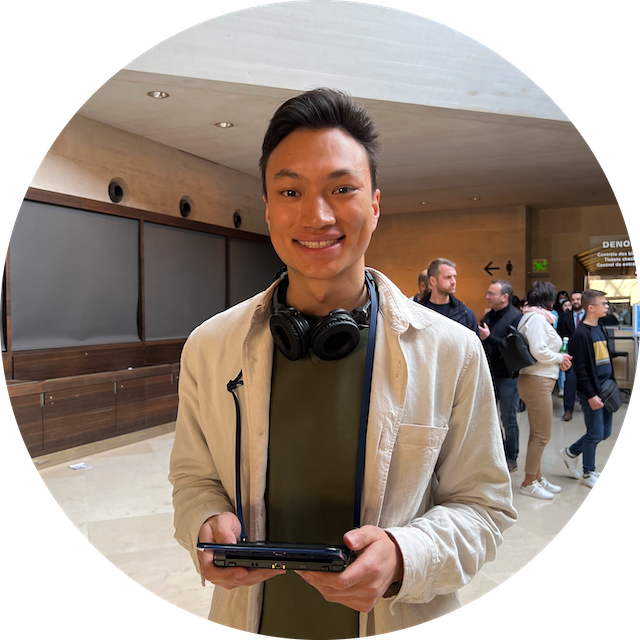
This is issue #4 of Stephen’s life updates for my friends. This will be a longer one as it’s been 10 months since my last monthly update. My commitment to the bit has not been good!
Realized dimensions
In Edwin Abbott’s Flatland, a square lives in a two-dimensional world and can’t conceive of “up” until he meets a sphere. Edward Tufte borrows the term in Envisioning Information:
“The world is complex, dynamic, multidimensional… How are we to represent the rich visual world of experience and measurement on mere flatland? This book celebrates escapes from flatland.”
An idea I’ve been pondering is that we all start out in a kind of flatland, and that growing up involves the slow accumulation of new dimensions — parts of the world you once couldn’t perceive, or perceived only very coarsely, that become visible with time and practice.
My recent project Lenses collects the conceptual dimensions that have become central to how I understand the world, like agency, communication, evolutionary psychology:
For many years — especially in college, with negative dollars in my bank account — I’d closed off a few experiential dimensions. Food was calories and nutrition per dollar. Furniture and clothes was function. Part of this was due to an Asian-immigrant frugality inherited from parents, where I’d feel guilty about eating sushi when rice and eggs got the job done. Part of it was a belief that I should focus on more “useful” dimensions, like school, work, and health. Everything else mostly seemed like a distraction.
Years later, I’ve been reopening old dimensions and finding new ones. Tinkering with the LFO knobs on my synth, returning a lamp because its Forest Green was a few shades too dark, and ordering the sushi.
My friend Neall calls the smaller objects of curiosity “little critters.” A critter might be something physical (like what’s up with those palm trees in Dolores Park?) or abstract (how is a meme born and how does it spread?).


I like the idea that the world is full of these hidden depths, waiting for the right question to reveal them. And what a joy it is to escape flatland and realize a few more dimensions every day. 🙂
A new chapter at Notion
Work has been a particularly busy chapter. I also just hit my 4-year anniversary. :-)


A new role
People say that being a Tech Lead Manager is a scam, because it’s like working two jobs — both being a pure engineer and an engineering manager at the same time. They are correct! It is a scam and it is like working two jobs, but I don’t regret it.
One of the experiences I most enjoy in life is being new at something: a new roguelike game, a new city, a new role. Everything is a hill you haven't climbed, and early progress is speedy. The first few times you do anything, you will probably suck at it, but you quickly pick up momentum — and suddenly you're looking down from a few small summits.
Management has its own realized dimensions, from “how do you recruit candidates well?” and “how do you juggle between business, team, technical, and user needs?” to more subtle dimensions like “how does information asymmetry lead to gaps in leadership and IC execution” or “how do managerial styles and incentive differences from different leaders change the projects that evolve under them?”.
I’ve often realized, “oh, this is what my ex-managers and mentors were trying to get me to understand about the many Chesterton’s fences that I was hopping over.”
A new kind of engineering
I’ve been helping with AI education at Notion for the past year. Part of this means trying many different tools, models, and strategies and sharing them out. It also means that being terminally online on X — unfortunately the “hub” of AI coding discussion — has become part of my job.


In May, I hosted an AI education camp for fifty engineers in Pescadero, CA’s Costanoa Lodge.


It seems as though every software company is grappling with adopting AI, trying to answer questions like: How much delegation to LLMs is acceptable, in PRs, RFCs, code reviews? How much does human input matter if the ideas or code are correct? If we delegate larger tasks to agents or loosen code review standards, do we ship and learn fast enough to make up for the problems and debt we incur?
And every answer seems to be: “It depends” with many asterisks. It’s hard to know what the future holds, and everyone has a different opinion.
I like this one:
My AI coding tools & models recs (8/31/2026)
Tools:
- Orca is my agent orchestration tool. It’s nice to be able to swap out the harness (Claude Code, Codex, Cursor, Omp) and bring your existing subscription plans.
- Zed: I use Zed whenever I need to look up code. It's faster than VSCode/Cursor with less memory footprint and bloat. I'm also still using GitHub Desktop to read local diffs when needed.
Models:
- ⭐ GPT 5.6 Sol or Opus 5 (medium) primary driver depending on the task. Sol for more input/output or backend shaped problems and Opus 5 for more "taste" shaped problems, like new UI or deciding abstractions.
- I do find the latest frontier model outputs to be very annoying to read, and use skills like STE and unslop to alleviate this.
- Fable 5 is just too expensive as the primary driver, but I do use Fable + Opus subagents from time to time.
- 🌶️ My looser opinions are that Kimi K3 is overrated, Luna Max with the 80% discount is a nice subagent but not good enough for serious coding, Terra doesn't seem worth micromanaging to, and Sonnet 5 is generally bad performance/price. Grok 4.6 is a good model overall for speed & quality and is good at doing what it’s told, but has bad taste so I don’t trust it for anything open-ended. But this is all very dependent on your budget.
(9/1: Fable 5.1 just came out, but I haven’t had a chance to try it yet. Sentiment seems solid!)
My general recommendation for people who don't want to think about models and tools at all is:
- Just use Codex UI + GPT 5.6 Sol. Unless you're a designer or design engineer, then use Claude Code UI + Opus 5 instead, because of the better taste.
- Default to Medium effort for this latest generation of models (Opus 5, Fable 5, 5.6 Sol). Tweak to higher for problems that you might spend many hours on doing by hand or complex plans and debugging.
I’ve also been having some fun with Grok Bot, which can also orchestrate Cursor agents or any coding agent via CLI on its computer.
A few new primitives
My team is called Primitive Foundations. We help build and advise on core building blocks of Notion. In March, we shipped Dashboards & number charts:
And I’m currently working on two new features: custom blocks and [secret project].
Making many things
Since the last issue, I’ve been building many coding side projects, thanks in large part to AI coding agents getting smarter.
For years, I had too many ideas locked away in a database, never to see the light of day because I didn’t have the time. Now the bottleneck is trying not to break the bank buying tokens and usage limits on AI plans.
This current age of AI coding for programmers feels as if you’re a firebender and every day is Sozin’s Comet.

I’m having so much fun!


A gallery of a few projects I’ve worked on:
wustep.me: website redesign, ft. a software playground
DOM-ino: experiment zone for pretext.js and DOM physics
Stagebench: AI benchmark for recreating the Nord Stage 4


Splashpanic: Crazy Arcade / Bomberman game clone
It’s a joy to be able to take an idea (“It might be fun to make a Sims world”) and turn it into reality in a few hours.
Matchmaking
One of my larger projects is a matchmaking app. I believe one of the most impactful things you can do — for relatively little effort — is connect your friends platonically or romantically.
I think two reasons why people don’t do this more are:
- mental overhead: if you have lots of friends, it’s hard to keep track of who they are and who’s looking for what and all their specific preferences
- network size: even the most extroverted people may still not have a large enough pool of friends to make many romantic matches, as it may take 40+ people to find a solid romantic match
So I set out to build matchmake.love for the hobbyist matchmaker. By pooling your friends with your friends’ friends, it becomes easier to find matches (platonic or romantic). By making it really easy to manage your list of friends, you’re more likely to do it.
My motivations are partly anthropological, and I’m curious about dimensions like:
- Matchmaking: What makes a good matchmaker? What attributes make for successful matches? Mutuals? Shared hobbies? Enneagram/MBTI?
- Preferences: How do people's revealed preferences differ from their stated ones, and how much do their stated preferences actually matter in the long run?
It’s also been nice to have a full stack platform that has room to design many surfaces and build lots of random infrastructure (like an AI agent you can text and a prototype playground).


If you’re interested in matchmaking your friends, try it out: https://matchmake.love (access code:
WUSTEP). It’s quite early and I’d love to hear your feedback.Writing
- Building Notion dashboards: an exploration into the product & design thinking of dashboards
- Headspace part 2: an essay on a conceptual framework
- Lenses: a collection of my favorite mental models
- Spot it!: breaking down the math and development of the game
- How to talk to coding agents: a guide for engineers on AI
Other happenings


Thanks for reading!
If you have any thoughts, want to catch up, or have stumbled onto a new dimension that you’d like to share — you know where to find me. 🙂
Best,
Stephen